

When your skin suddenly feels dry, tight, sensitive or uncomfortable, it is easy to assume that you need a stronger product.
You may reach for another exfoliant, a new serum or a treatment promising faster results.
Very often, your skin is asking for the opposite.
It may need less stimulation, more protection and time to recover.
Your skin barrier is one of the most important parts of healthy skin, yet it is also one of the most misunderstood. It plays a central role in keeping moisture inside the skin and helping protect you from irritants in the outside world.
When it is working well, your skin usually feels calm, comfortable and resilient.
When it is struggling, almost everything can feel more difficult. Products may sting. Makeup may sit unevenly. Dry patches may appear, and skin that previously tolerated active ingredients may suddenly become reactive.
At Sorelle Clinic, I always look at the condition of the skin before thinking about stronger treatments.
That is The Donna Way.
We do not push the skin simply because we can. We listen to it, understand what it needs and create the right foundation before asking it to do more.
What Is Your Skin Barrier?
Your skin is made up of several layers.
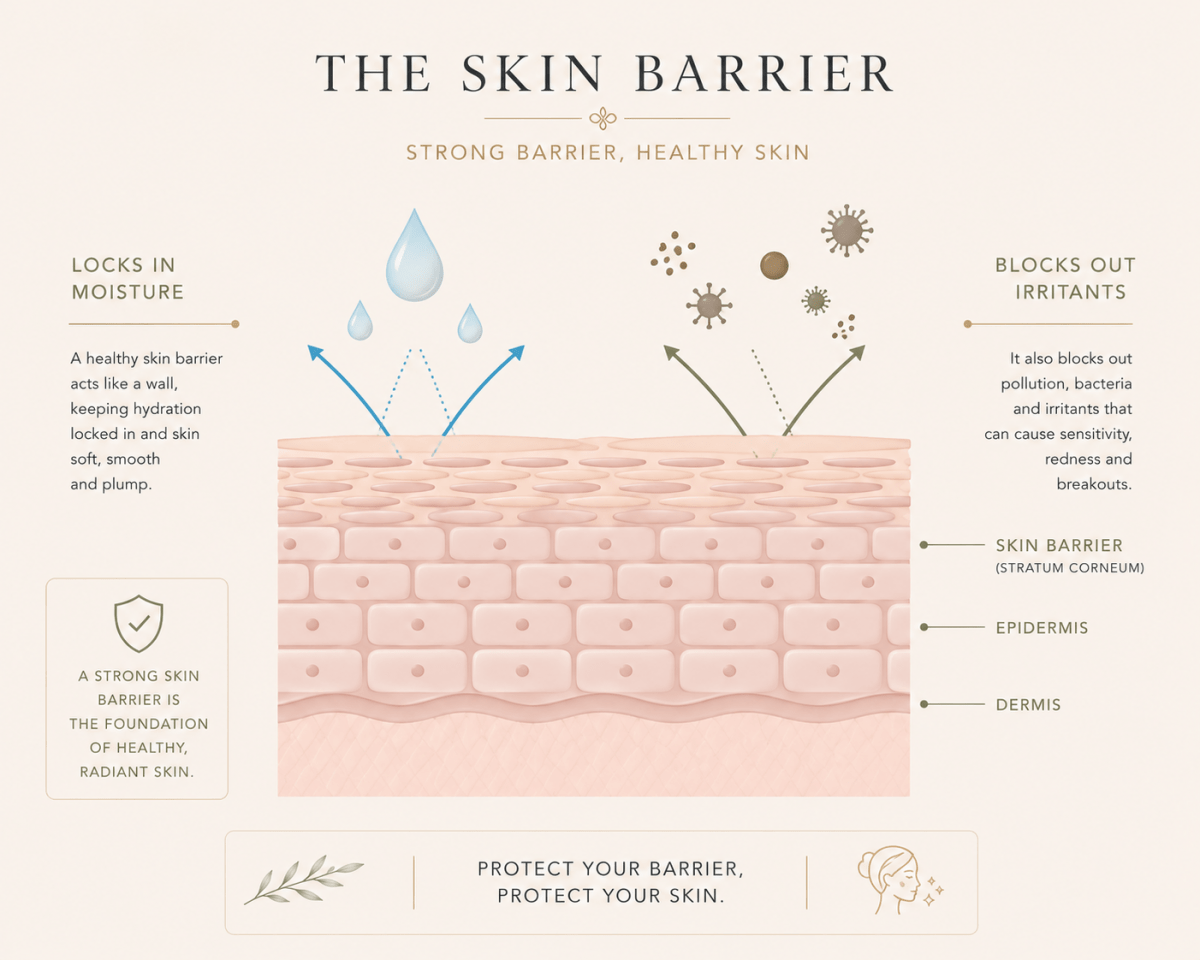
The skin barrier refers mainly to the outermost part of the epidermis, known as the stratum corneum.
Although it is very thin, it has an incredibly important job.
It helps keep water inside your skin while reducing the entry of potential irritants, allergens and microorganisms.
A simple way to imagine it is as a carefully built wall.
The skin cells form the bricks. Natural fats, including ceramides, cholesterol and fatty acids, help form the material between those bricks.
When everything is arranged properly, the wall is strong and water is less able to escape.
When gaps begin to develop, moisture can leave more easily and irritating substances can enter more readily.
The result may be skin that feels dry, rough, itchy, sensitive or inflamed.
The British Association of Dermatologists explains that emollients help protect and moisturise the outer layer of the skin by keeping water in and supporting protection from outside irritants.
Why Your Skin Barrier Matters
A healthy skin barrier does much more than prevent dryness.
It supports the overall function, appearance and comfort of your skin.
When your barrier is healthy, your skin is better able to retain hydration. This can help it feel softer, smoother and more supple.
It is also more likely to tolerate your skincare routine without constant stinging or redness.
A strong barrier can support:
- Comfortable hydration
- A smoother skin texture
- Greater resilience
- Reduced sensitivity to everyday irritants
- More consistent skincare results
- A calmer and more balanced appearance
This is why I believe healthy skin must come before beautiful skin.
If the foundation is struggling, adding more active ingredients will not always create better results. It can sometimes make the problem worse.
Before we work on pigmentation, fine lines or texture, we need to make sure your skin feels safe, supported and able to function properly.
Is a Damaged Skin Barrier a Medical Diagnosis?
The phrase damaged skin barrier is commonly used in skincare, but it can describe a range of situations.
Sometimes it refers to temporary irritation caused by using too many products.
In other cases, dryness, itching or inflammation may be connected to a skin condition such as eczema, rosacea, psoriasis, contact dermatitis or an allergy.
This is why it is important not to diagnose every rash or uncomfortable patch as simple barrier damage.
If your symptoms are severe, persistent, spreading or affecting your daily life, professional medical advice is appropriate.
Skincare can support the outer layer of your skin, but it cannot replace diagnosis or treatment for a medical condition.
Signs Your Skin Barrier May Be Struggling
Your skin barrier does not always announce that it is in difficulty.
The signs can build gradually, particularly if you have been using strong products for a long time.
Common signs include:
- Tightness after cleansing
- Dry or flaky patches
- Increased redness
- Itching or discomfort
- A rough or uneven texture
- Products suddenly beginning to sting
- Greater sensitivity to heat or cold
- Skin that feels oily on the surface but dry underneath
- Breakouts alongside irritation
- Makeup no longer sitting smoothly
Cleveland Clinic includes dryness, scaling, inflammation, irritation, itching, roughness, tenderness and stinging when products are applied among the signs associated with a weakened skin barrier.
One of the most useful clues is change.
Perhaps your skin has always tolerated a particular serum, but now it burns when you apply it.
Perhaps your face feels tight even though you are using moisturiser.
Perhaps you have started reacting to several products at once.
These changes can suggest that your skin needs a gentler approach.
Can Oily Skin Have a Weak Skin Barrier?
Yes.
A weakened barrier is not limited to dry skin.
Oily and blemish prone skin can also become dehydrated, irritated and sensitive.
This often happens when someone tries to control oil by using harsh cleansers, frequent exfoliation or several strong acne products together.
The surface may continue to look shiny, while the skin underneath feels tight and uncomfortable.
This can be confusing because the natural response is often to cleanse more aggressively.
In many cases, the skin needs balance rather than more stripping.
Oily skin still needs hydration, moisturiser and barrier support.
The texture of the products may be different, but the basic need for protection remains the same.
What Can Weaken the Skin Barrier?
Many different factors can affect barrier function.
Some are related to skincare. Others are connected to the environment, age or health.
Cleansing Too Aggressively
A cleanser should remove makeup, sunscreen and daily build up without leaving your face feeling painfully tight.
Very hot water, harsh soaps and repeated cleansing can remove too much of the oil that helps protect the skin.
Clean skin should feel comfortable, not stripped.
Exfoliating Too Often
Exfoliation can be useful when it is chosen carefully and used at the right frequency.
Problems begin when several exfoliating acids, scrubs or resurfacing products are layered together.
More exfoliation does not always mean faster results.
Repeated irritation can lead to redness, sensitivity and an uneven surface.
Using Too Many Active Ingredients
Retinoids, exfoliating acids, vitamin C products and blemish treatments can all have a place in a good routine.
The difficulty comes when too many are introduced at once or used more frequently than the skin can tolerate.
A product may be effective and still be wrong for your skin at that moment.
Constantly Changing Your Routine
Your skin needs consistency.
Changing products every few days makes it difficult to understand what is helping and what is causing irritation.
It can also expose your skin to a constant stream of new fragrances, preservatives and active ingredients.
Environmental Conditions
Cold weather, wind, indoor heating and low humidity can all increase dryness.
This is one reason skin often feels more uncomfortable during a British winter.
Sun exposure can also place stress on the skin, which is why daily protection remains important throughout the year.
Professional Treatments Without Suitable Aftercare
Advanced treatments can create excellent results when they are carefully selected and followed by proper aftercare.
However, introducing strong products too soon after a treatment or ignoring professional guidance can increase irritation.
Your home routine and clinic treatments should support each other.
Why Skin Can Become More Sensitive After 40
Many women tell me that products they used for years suddenly feel too strong.
This can be frustrating, but it is not unusual.
As we get older, skin can become drier and may take longer to recover from irritation.
Hormonal changes during perimenopause and menopause can also affect hydration, oil production and sensitivity.
You may notice:
- Increased dryness
- More frequent redness
- Greater sensitivity to active ingredients
- A thinner or less cushioned feeling
- Slower recovery after treatments
- Changes in texture
This does not mean your skin has become difficult.
It means its needs have changed.
The solution is not always to abandon effective skincare. It may simply be necessary to adjust the strength, frequency, texture or combination of products.
At this stage, personalised advice becomes especially useful because the routine that worked at 30 may not be the routine your skin needs at 45 or 55.
Sorelle Clinic also recognises that skin can become more prone to dryness, sensitivity and environmental stress as it changes with age.
How to Support Your Skin Barrier
When your skin feels irritated, the first step is usually to simplify.
You do not need to buy an entirely new shelf of products.
You need to remove unnecessary pressure and return to the basics.
Step One: Use a Gentle Cleanser
Choose a mild cleanser that does not leave the skin feeling tight.
Avoid very hot water and aggressive rubbing.
In the morning, some people may find that a splash of lukewarm water is enough, particularly when the skin is very dry or sensitive.
In the evening, cleansing is important for removing makeup, sunscreen and daily dirt.
The aim is to clean the skin without punishing it.
Step Two: Pause Unnecessary Active Products
When your skin is stinging, flaky or inflamed, it may be sensible to pause exfoliating acids, scrubs and stronger active ingredients.
This does not mean you can never use them again.
It means your skin may need a period of calm before they are reintroduced carefully.
Step Three: Apply a Suitable Moisturiser
Moisturisers and emollients help soften the skin and reduce water loss.
The NHS explains that emollients form a protective film over the skin that helps trap moisture.
Choose a texture that feels comfortable.
A dry skin may prefer a richer cream.
An oily skin may prefer a lighter lotion or gel cream.
Sensitive skin may benefit from a simple, fragrance free formulation.
Step Four: Protect Your Skin from Sunlight
Daily broad spectrum SPF helps protect the skin from ultraviolet exposure.
When the barrier is already struggling, avoiding further environmental stress is particularly important.
Apply SPF as the final step of your morning routine and follow the instructions for reapplication when spending time outside.
Step Five: Give Your Skin Time
Skin recovery is rarely instant.
How long it takes depends on what caused the problem, how severe it is and whether an underlying condition is present.
Some mild irritation may settle after simplifying your routine.
More persistent problems may require professional assessment.
Try not to become impatient and introduce several new products after a few days.
Calm and consistency are part of the treatment.
Which Skincare Ingredients Can Support the Barrier?
Ingredient lists can feel overwhelming, so it helps to understand the role of a few common groups.
Ceramides
Ceramides are fats found naturally in the outer layer of the skin.
They contribute to the structure that helps limit water loss and support protection.
Research has examined moisturisers containing ceramides, cholesterol and fatty acids because these lipids play important roles within the skin barrier.
Glycerin
Glycerin is a humectant.
This means it helps attract water and support hydration within the outer layer of the skin.
It is widely used in moisturisers and gentle hydrating products.
Hyaluronic Acid
Hyaluronic acid can help attract and hold water.
It can be useful for dehydration, but it is not a complete barrier routine by itself.
A moisturiser applied afterwards can help reduce moisture loss.
Squalane
Squalane is a lightweight moisturising ingredient that can help soften the skin.
Many people find it comfortable because it does not usually feel as heavy as some richer oils.
Petrolatum
Petrolatum forms a protective layer over the skin and can help reduce water loss.
It can be particularly useful for very dry areas, although it may feel too rich for some people to use across the whole face.
Panthenol
Panthenol is often included in calming and moisturising products.
It can support hydration and comfort when used in a well formulated product.
No individual ingredient guarantees that a product will suit you.
The complete formula matters, as do your skin type, allergies and current condition.
What Should You Avoid While Your Skin Recovers?
When your skin barrier feels vulnerable, try to avoid adding more irritation.
This may mean temporarily reducing or stopping:
- Facial scrubs
- Strong exfoliating acids
- Frequent retinoid use
- Highly fragranced products
- Harsh foaming cleansers
- Very hot water
- Cleansing brushes
- Picking or rubbing flaky skin
- Several new products introduced together
- Unplanned treatments while the skin is inflamed
The purpose is not to create fear around active skincare.
Active ingredients can be extremely valuable when they are introduced at the right time and in the right way.
The question is not whether an ingredient is good or bad.
The question is whether it is right for your skin today.
How Long Does Skin Barrier Recovery Take?
There is no single recovery time that applies to everyone.
Mild irritation caused by one unsuitable product may improve relatively quickly once the trigger is removed.
Skin that has been repeatedly over exfoliated may need longer.
A chronic condition will require a different approach from temporary cosmetic irritation.
Your recovery may also be affected by:
- Your age
- Your general health
- Hormonal changes
- The severity of irritation
- Your environment
- The products you continue to use
- Whether an underlying skin condition is present
Rather than watching the calendar, watch how your skin behaves.
Is it less tight?
Are products stinging less?
Is the redness settling?
Does your moisturiser feel more comfortable?
These are useful signs that your skin may be becoming more settled.
When Should You Seek Professional Advice?
Please do not assume that every persistent skin problem can be fixed by changing moisturiser.
Speak with a pharmacist, GP or dermatologist when symptoms are severe, painful, spreading or persistent.
You should also seek appropriate advice if you experience:
- Swelling
- Blistering
- Crusting or weeping
- Signs of infection
- Severe itching
- A sudden widespread rash
- Symptoms around the eyes
- Reactions affecting breathing
- A problem that repeatedly returns
- Skin changes that concern you
A professional skin consultation can help with cosmetic routines and treatment planning, but medical symptoms require the right medical professional.
Knowing when not to treat the skin is part of responsible skin care.
Professional Treatments and Barrier Health
Not every facial should focus on exfoliation or stimulation.
Sometimes the most appropriate treatment is one that supports hydration, comfort and healthy renewal.
Sorelle Clinic offers facial approaches intended to improve hydration and support barrier function, with treatment selection based on the needs of the individual skin.
Before recommending a treatment, I consider:
- How your skin feels
- What you are currently using
- Whether you are experiencing sensitivity
- Your previous treatment history
- Hormonal and lifestyle changes
- What you want to achieve
A good treatment plan should respect your skin rather than forcing it to tolerate more than it can manage.
The Donna Way
The Donna Way begins with listening.
Your skin communicates through tightness, redness, sensitivity, texture and changes in comfort.
Our job is not to silence those messages with stronger and stronger products.
Our job is to understand them.
I believe that the best skin results begin with a healthy foundation.
That may mean slowing down.
It may mean simplifying your routine.
It may mean focusing on hydration before introducing a retinoid or choosing a calming facial rather than an intensive peel.
There is no failure in taking a gentler approach.
Sometimes gentleness is exactly what allows the skin to become stronger.
At Sorelle Clinic, your treatment plan is a partnership. Donna’s approach focuses on evidence informed treatments that are customised to the individual rather than applying the same routine to everyone.
Your skin does not need to behave like anyone else’s skin.
It simply needs the right care for where it is today.
Frequently Asked Questions
What is the skin barrier?
The skin barrier is the protective outer layer of your skin. It helps retain water and limits the entry of irritants, allergens and microorganisms.
How do I know if my skin barrier is damaged?
Possible signs include dryness, tightness, flaking, redness, itching, stinging and increased sensitivity. However, these symptoms can also be linked to medical skin conditions, so persistent problems should be assessed appropriately.
Can over exfoliation damage the skin barrier?
Using exfoliating products too frequently can irritate the skin and affect its protective outer layer. Exfoliation should be matched to your skin type, tolerance and wider routine.
Should I stop using retinol if my skin barrier is irritated?
It may be sensible to pause retinol and other strong active ingredients while the skin is irritated. Reintroduce them gradually once your skin feels calm, ideally with personalised advice.
Can moisturiser repair the skin barrier?
A suitable moisturiser can support barrier function by improving hydration and reducing water loss. It may not resolve an underlying medical condition, so seek professional advice if symptoms continue.
Can oily skin have a damaged barrier?
Yes. Oily skin can still be dehydrated and sensitive. Harsh cleansing and excessive blemish treatments may leave it feeling both oily and tight.
Are ceramides good for the skin barrier?
Ceramides are naturally present in the outer layer of the skin and help form part of its protective structure. Products containing ceramides may be helpful, although the complete formulation still matters.
How long does it take to repair the skin barrier?
Recovery time varies. Mild irritation may settle after simplifying the routine, while more significant or persistent symptoms can take longer and may require professional assessment.
Should I exfoliate while repairing my barrier?
It is generally sensible to pause unnecessary exfoliation when the skin feels inflamed, tight, flaky or painful. Focus on gentle cleansing, moisturising and protection.
Does the skin barrier become weaker with age?
Ageing and hormonal changes can contribute to dryness and increased sensitivity. Your routine may need to become more nourishing and less aggressive over time.
Conclusion
Understanding your skin barrier changes the way you care for your skin.
Instead of asking how quickly you can exfoliate, brighten or resurface it, you begin by asking whether it feels calm, hydrated and protected.
A healthy barrier helps your skin retain moisture, tolerate suitable products and respond more consistently to professional treatments.
When it is struggling, the most effective response is often simple.
Cleanse gently.
Pause unnecessary active ingredients.
Use a suitable moisturiser.
Apply daily SPF.
Give your skin time.
Most importantly, pay attention to what your skin is telling you.
At Sorelle Clinic, The Donna Way is not about chasing stronger treatments or perfect skin.
It is about creating healthy skin through personalised guidance, thoughtful treatment and consistent care.
Because when your skin feels safe and supported, everything else has a stronger foundation.
Sources
- NHS guidance on emollients and their role in soothing, hydrating and trapping moisture in the skin.
- British Association of Dermatologists guidance on emollients and protecting the outer layer of the skin.
- Cleveland Clinic guidance on common signs associated with a weakened skin barrier.
- Published research examining ceramide containing moisturisers and the lipids involved in skin barrier structure.
- Sorelle Clinic information about hydration, barrier support and personalised skin treatments.