When women ask me where to begin with skincare, my answer is often much simpler than they expect.
Before we discuss active serums, advanced facials or treatments designed to improve skin texture, we need to talk about protection.
SPF is one of the most important parts of any skincare routine. It protects the progress you have already made and helps prevent further damage from occurring.
You can invest in beautiful products and professional treatments, but without consistent sun protection, your skin is still being exposed to one of the main causes of visible skin ageing.
At Sorelle Skin Clinic, this is part of The Donna Way. We look after the health of your skin first. That means protecting it every day, not only when the sun feels hot or when you are going on holiday.
Daily SPF is not about being frightened of daylight. It is about making one small, sensible choice that supports your skin for years to come.
SPF Is More Than a Summer Product
Many of us grew up thinking sunscreen belonged in a beach bag.
We applied it during a summer holiday, on especially hot days or when we could feel the sun burning our skin. Once autumn arrived, the bottle went back into the cupboard.
We now understand that sun protection should not be limited to warm weather.
Ultraviolet radiation can reach the skin even when the temperature is cool. The brightness or warmth of the day does not always tell you how much ultraviolet exposure your skin is receiving.
This is particularly important in the UK, where cloudy skies can give us a false sense of security.
You may not feel as though you are in strong sunshine, but your skin is still exposed during everyday activities such as driving, walking to work, sitting near a window or spending time outdoors.
Daily application removes the need to make a new decision every morning. SPF simply becomes part of your routine, just like cleansing your teeth.
What Do UVA and UVB Mean?
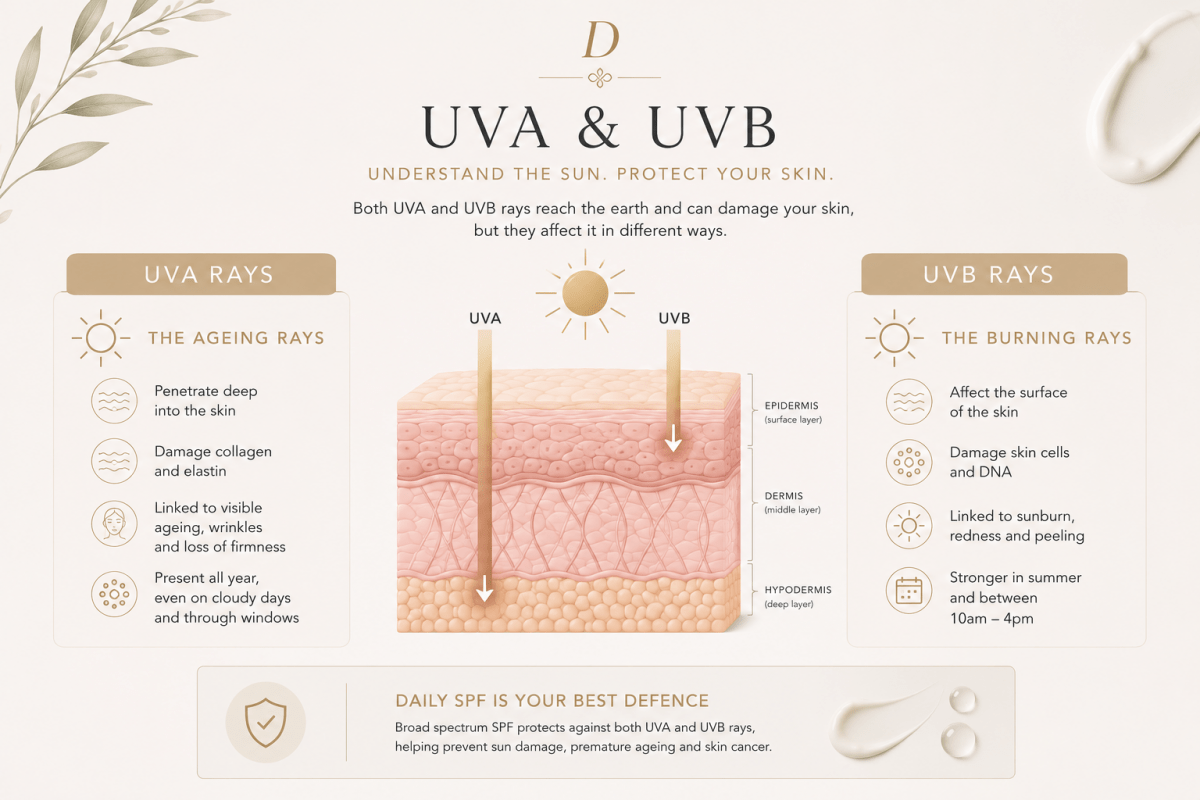
Sunlight contains different types of ultraviolet radiation. The two we usually discuss in relation to skin are UVA and UVB.
UVA Rays
UVA rays penetrate more deeply into the skin and contribute to changes such as pigmentation, fine lines, loss of firmness and uneven texture.
They are present throughout the year and can pass through glass. This means your skin may still receive UVA exposure while you are driving or sitting beside a window.
I often describe UVA as the type of exposure linked with visible ageing. That is not the full scientific definition, but it is a helpful way to remember why UVA protection matters.
UVB Rays
UVB rays are strongly associated with sunburn and direct damage to the surface of the skin.
Their intensity changes according to the season, location, time of day and weather conditions.
Both UVA and UVB can damage skin, which is why I recommend choosing a sunscreen that provides broad spectrum protection rather than focusing only on the SPF number.
The NHS advises choosing at least SPF 30 for UVB protection and at least four star UVA protection. A UVA symbol inside a circle can also indicate that the product meets the relevant European standard.
What Does the SPF Number Mean?
SPF stands for Sun Protection Factor.
The number mainly tells you about the level of protection offered against UVB radiation when the product is applied correctly.
It does not mean that SPF 50 allows you to stay in the sun all day without reapplying. It also does not mean that you are completely protected from every form of sun damage.
No sunscreen can provide complete protection. Cancer Research UK recommends using sunscreen alongside shade and suitable clothing rather than using it as a reason to spend longer in direct sunlight.
For everyday use, I generally encourage clients to choose a broad spectrum product with at least SPF 30 and strong UVA protection. Some people may prefer SPF 50, particularly when pigmentation is a concern, when the skin is more sensitive to sunlight or when they are spending extended time outdoors.
The most important product is one that offers suitable protection and feels comfortable enough for you to apply consistently.
How Sun Exposure Changes Your Skin
Sun damage rarely appears all at once.
It accumulates quietly over time.
You may not notice a change after one walk, one drive or one afternoon in the garden. Over the years, however, repeated exposure can contribute to visible changes in the skin.
These changes may include:
- Fine lines
- Uneven pigmentation
- Dark patches
- Rougher texture
- Reduced firmness
- Loss of radiance
- Persistent redness
Ultraviolet exposure can affect collagen and other structures that help the skin look firm and supported.
This is one reason I see SPF as an essential part of healthy ageing. It does not stop the natural ageing process, and that should never be the goal. It simply helps protect your skin from avoidable damage.
Your skin will change as you get older. That is normal. Our aim is to help it remain as healthy, resilient and confident as possible at every stage.
Why SPF Matters After 40
Skin often begins to feel different during our forties and beyond.
You may notice that it feels drier, takes longer to recover or no longer has the same natural bounce. Pigmentation can become more visible, and previous sun exposure may start to show more clearly.
Hormonal changes can also affect hydration, sensitivity, collagen and the way pigmentation behaves.
At this stage, many women begin investing in more targeted skincare and professional treatments. They may introduce ingredients designed to support collagen, improve texture or brighten uneven tone.
SPF helps protect that investment.
There is little value in working hard to improve pigmentation while allowing daily ultraviolet exposure to stimulate it again. In the same way, treatments designed to support collagen should be accompanied by habits that reduce unnecessary damage.
I never want skincare to feel like a punishment or a list of impossible rules. Daily SPF is simply one of the most effective ways to respect the work you are already doing for your skin.
Does SPF Prevent Ageing?
SPF does not prevent natural ageing.
Nothing does, and I would never want to suggest that ageing is something we need to fear.
What sunscreen can do is help protect the skin from ultraviolet damage that contributes to premature visible ageing.
There is an important difference.
Natural ageing is part of life. It reflects experience, expression and time.
Premature skin ageing occurs when external factors cause changes earlier or more intensely than they might otherwise have developed.
Daily sun protection supports healthy ageing by reducing one of the major environmental pressures placed on the skin.
This is why I often say that SPF is one of the most valuable products in your skincare routine. It is not promising to turn back time. It is helping you look after the skin you have today.
Can I Skip SPF on Cloudy Days?
Clouds do not automatically mean there is no ultraviolet exposure.
Although the amount of radiation reaching the ground varies, you cannot judge your level of exposure by temperature alone.
A cold, bright day can still expose your skin to ultraviolet radiation. A warm day can also be less intense than expected. The daily ultraviolet index can help you understand the level of risk when planning outdoor activities.
For a simple and consistent skincare routine, many people choose to apply facial SPF every morning throughout the year.
This is particularly sensible when you are using ingredients or having treatments that can make your skin more sensitive to sunlight.
It also means that unexpected time outdoors does not catch you unprepared.
Do Darker Skin Tones Need SPF?
Yes.
Melanin provides some natural protection, but it does not make the skin immune to ultraviolet damage.
Every skin tone can experience sun damage.
For deeper skin tones, uneven pigmentation and dark marks may be a particular concern. Sun exposure can make existing pigmentation appear more noticeable or cause it to remain for longer.
The challenge is often finding a sunscreen that blends beautifully without leaving a pale or grey cast.
Modern formulations offer more choice than ever. Some products are transparent, lightly tinted or designed specifically to blend across a wider range of skin tones.
The right SPF should protect your skin and feel pleasant to wear. You should not have to accept an uncomfortable texture or an unsuitable finish simply because you have been told that sunscreen is important.
How to Choose the Right SPF
There is no single perfect sunscreen for everyone.
Your choice should be based on your skin, your routine and how the product feels when you wear it.
Look for the following features:
- At least SPF 30
- Broad spectrum protection
- Strong UVA protection
- A texture suitable for your skin type
- A finish you are happy to wear daily
- Water resistance when swimming, sweating or exercising outdoors
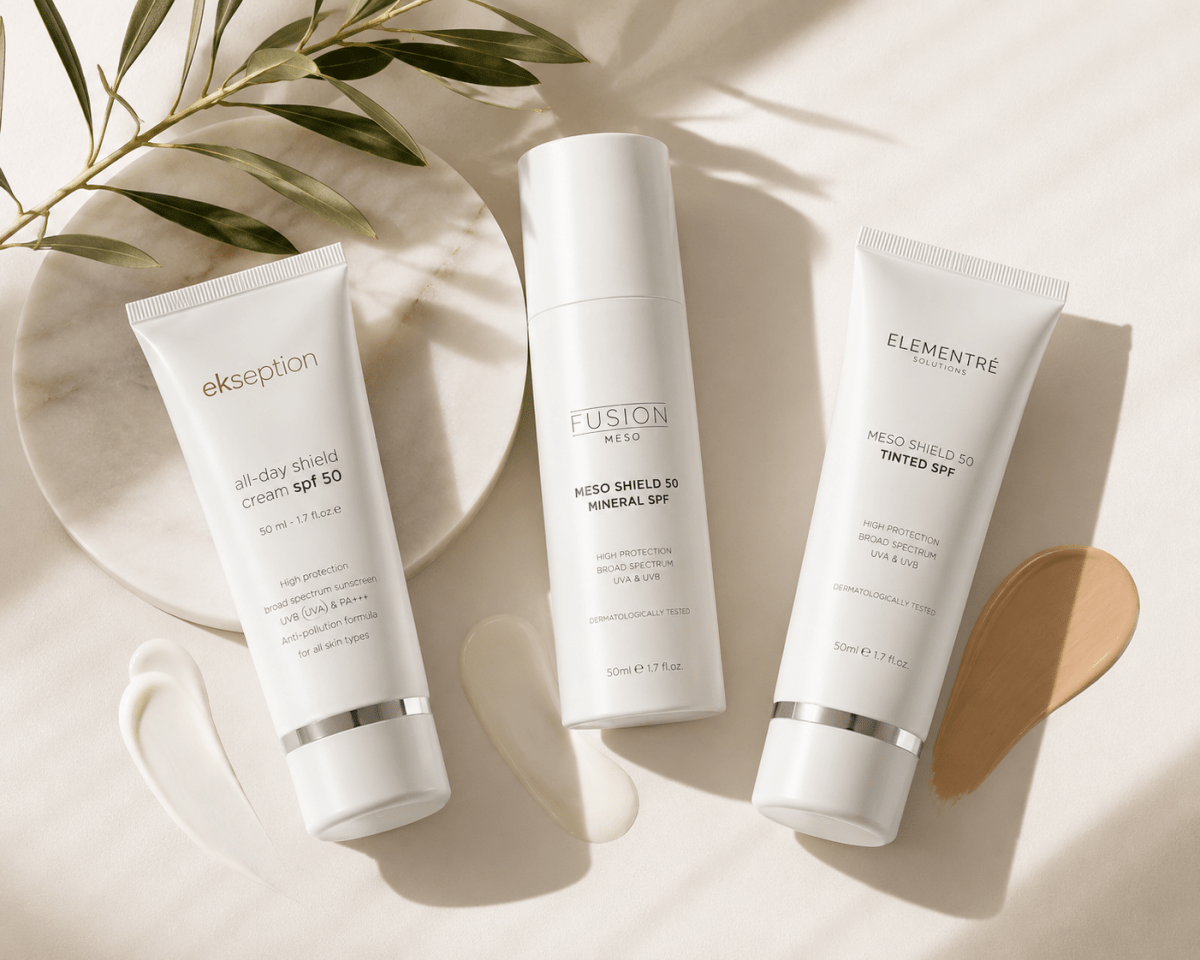
Dry skin may feel more comfortable with a moisturising cream.
Oily or blemish prone skin may prefer a lighter fluid or gel texture.
Sensitive skin may benefit from a simple formula chosen with professional guidance.
Skin with pigmentation concerns may benefit from high protection and, in some cases, a tinted formula.
The British Association of Dermatologists recommends choosing SPF 30 or above and checking for a UVA logo on the packaging.
The best SPF is not automatically the most expensive one. It is the one that gives appropriate protection, suits your skin and becomes a consistent part of your morning. You can find SPF protection here on the Sorelle Clinic Store.
When Should SPF Be Applied?
SPF should be the final skincare step in your morning routine.
A simple routine may look like this:
- Cleanse
- Apply your chosen serum
- Apply moisturiser if needed
- Apply SPF
- Allow it to settle before applying makeup
Some sunscreens are moisturising enough that you may not need a separate moisturiser underneath. This will depend on your skin and the formula you use.
Makeup should be applied after your sunscreen.
Foundation or tinted moisturiser containing SPF can provide some additional protection, but it is usually difficult to apply enough makeup to achieve the level of protection shown on the label.
For that reason, I prefer to see makeup with SPF as an extra rather than your main source of protection.
How Much SPF Should You Apply?
One of the most common problems with sunscreen is not the product itself. It is the amount being applied.
Applying a very thin layer may mean you are not receiving the level of protection shown on the bottle.
The face, ears and neck all need attention. The chest and hands should also be considered when they are exposed.
Apply the product evenly and avoid forgetting areas such as the hairline, around the eyes, the sides of the face and the tops of the ears.
When spending time outdoors, sunscreen should be reapplied regularly, particularly after swimming, sweating or towelling the skin.
The NHS advises applying sunscreen generously and frequently, following the instructions on the product. It also recommends combining sunscreen with clothing and shade.
Do You Need to Reapply SPF Over Makeup?
Reapplication is especially important when you are outdoors for an extended period.
On a normal working day, your needs may be different from a day spent walking, gardening, attending an outdoor event or sitting by a pool.
When you are outside, reapply according to the product instructions and after swimming, sweating or rubbing the skin.
Applying sunscreen over makeup can feel inconvenient. Some people use a sponge to press a fluid formula gently over makeup. Others choose a suitable mist or other product designed for reapplication.
The important point is not to assume that one light application early in the morning will provide unlimited protection throughout a long day outdoors.
Your routine should reflect what you are actually doing that day.
Common SPF Mistakes
Only Wearing It in Summer
Your skin can receive ultraviolet exposure outside the summer months. Making SPF a daily habit is simpler than trying to decide whether the weather looks sunny enough.
Applying Too Little
A tiny amount may not provide the protection stated on the packaging. Apply an even, generous layer to all exposed areas.
Missing the Neck and Ears
The face is not the only area exposed. Remember the ears, neck, chest and hands when they are uncovered.
Relying Only on Makeup
Makeup containing SPF can be helpful, but most people do not apply enough to rely on it as their main protection.
Forgetting to Reapply Outdoors
Sunscreen needs to be reapplied during extended sun exposure and after swimming, sweating or towelling.
Assuming a High SPF Lasts All Day
A higher number does not remove the need for correct application or reapplication.
Using SPF to Stay in the Sun Longer
Sunscreen should be combined with shade, clothing, hats and sensible decisions about exposure. It should not be used to extend time in strong sunlight.
SPF and Professional Skin Treatments
Sun protection becomes especially important when you are having professional skin treatments.
Some treatments work by encouraging renewal or creating a controlled response within the skin. Your practitioner may advise you to avoid strong sun exposure and use a suitable SPF before and after treatment.
Following this advice can help support recovery and reduce the risk of unwanted pigmentation or irritation.
This is one reason I take time to understand your lifestyle before recommending a treatment plan. Your skincare, treatments and daily habits all need to work together.
A treatment is not a separate event. It is part of your wider skin journey.
The Donna Way
The Donna Way is about making thoughtful choices that support your skin for the long term.
It is not about perfection.
It is not about hiding from the sun.
It is not about feeling guilty because you forgot your sunscreen once.
It is about understanding that small habits matter.
Applying SPF each morning may seem like a simple step, but that simple step helps protect your skin barrier, supports a more even complexion and helps preserve the results of your skincare and treatments.
I want every woman who comes to Sorelle Clinic to feel informed, confident and in control of her choices.
You do not need an overflowing bathroom cabinet.
You need the right routine, the right guidance and the consistency to give your skin what it needs.
For me, daily SPF is not an optional extra.
It is part of caring for your skin with respect.
Frequently Asked Questions
Should I wear SPF every day in the UK?
Many people choose to use facial SPF every day because UVA exposure can occur throughout the year. Daily use is especially important when the ultraviolet index is elevated, when you are spending time outdoors or when your skin is sensitive to sunlight.
Is SPF 30 enough for everyday use?
The NHS recommends at least SPF 30 with a minimum four star UVA rating. Some people may prefer SPF 50, especially when pigmentation, photosensitivity or prolonged outdoor exposure is a concern.
Should I use SPF 30 or SPF 50?
Both can provide useful protection when applied correctly. SPF 50 may be a sensible choice for people who burn easily, have pigmentation concerns or spend significant time outdoors. Correct application and reapplication still matter.
Does moisturiser with SPF count?
It can offer protection when enough is applied, but many people use only a small amount of moisturiser. A dedicated sunscreen may make it easier to apply an appropriate and even layer.
Can I wear SPF under makeup?
Yes. Apply sunscreen as the final step of your morning skincare routine, allow it to settle and then apply your makeup.
Can I use the same sunscreen on my face and body?
You can, provided the product is suitable for both areas and feels comfortable on your face. Facial sunscreens are often designed with lighter textures that sit more easily beneath makeup.
Does sunscreen stop vitamin D production?
Sunlight contributes to vitamin D production, but sunburn and intentional unprotected exposure are not recommended ways to manage vitamin D levels. Anyone concerned about vitamin D should speak with a pharmacist or health professional about safe sources and supplementation.
Do I need SPF if I work indoors?
Your exposure will usually be lower indoors, but UVA can pass through glass. Your personal needs will depend on how close you are to windows, how much time you spend driving and whether you go outside during the day.
Can sunscreen cause breakouts?
Some formulations may not suit every skin type. Look for a lighter product designed for blemish prone skin and introduce it carefully. A skin consultation can help when repeated reactions or breakouts make choosing products difficult.
Is sunscreen enough on its own?
No. Sunscreen is one part of sun protection. Shade, clothing, hats and avoiding excessive exposure are also important, particularly when the sun is strong.
Conclusion
Why does SPF matter every day?
Because healthy skin needs protection as well as treatment.
Daily sunscreen helps reduce the ultraviolet damage associated with sunburn, uneven pigmentation and premature visible ageing. It also helps protect the work you are already doing through your skincare routine and professional treatments.
You do not need to become obsessed with avoiding daylight. You simply need to build sensible protection into your day.
Choose a broad spectrum sunscreen that suits your skin. Apply it generously. Reapply when you are spending extended time outside. Support it with shade and protective clothing when needed.
At Sorelle Clinic, The Donna Way is always about creating healthy, sustainable habits rather than chasing quick fixes.
Beautiful skin begins with healthy skin, and healthy skin deserves daily protection.
Sources
- NHS guidance on sunscreen and sun safety, including SPF and UVA recommendations.
- British Association of Dermatologists sunscreen information and product selection guidance.
- Cancer Research UK guidance on combining sunscreen with shade and protective clothing.
- Sorelle Clinic brand philosophy and approach to personalised skin health.